Run the free AI readiness check
Connect a Salesforce sandbox or production org through Claude and Nexus MCP. Get a signal-only report across data, automation, access, and adoption.
Free Salesforce AI Readiness Check
Check whether your Salesforce org has the data, automation, access, and process-context risks that make AI agents unreliable before Agentforce, Claude, Gemini, or an internal agent touches real work.
Runs in Claude through Salesforce OAuth. Sandbox supported. You see access details before approving.
Start with a signal-only readiness check. If the scan shows risk, the Blueprint turns those findings into a ranked cleanup path and first safe AI use cases.
No sales call required to see the setup, access details, and sample output.
The problem
Bad fields, brittle automation, broad permissions, and missing process context do not disappear when an AI layer sits on top. They become the inputs and actions your agent depends on.
Duplicate contacts, missing amounts, stale stages, and unclear ownership give agents weak inputs before the first prompt runs.
Active flows and legacy Process Builder logic can turn a simple AI action into a hidden side effect.
AI tools stay safer when permissions match the work an agent should perform.
If business meaning lives in tickets, Slack threads, and tribal knowledge, an agent will guess where a human would ask.
The free check gives you a first read on AI-readiness risk. The paid Blueprint adds human review, ranked priorities, and a cleanup path before anyone touches production work.
The same Salesforce risks matter whether your team chooses Agentforce, Claude, Gemini, or an internal agent stack.
The free diagnostic looks for candidate risks across data quality, automation, access, and adoption signals. It does not give destructive cleanup instructions.
The Blueprint turns scan output into a ranked AI-readiness roadmap, candidate use cases, and a 30/60/90 cleanup sequence.
Implementation starts with one blocker at a time. No open-ended retainer. No vague transformation project.
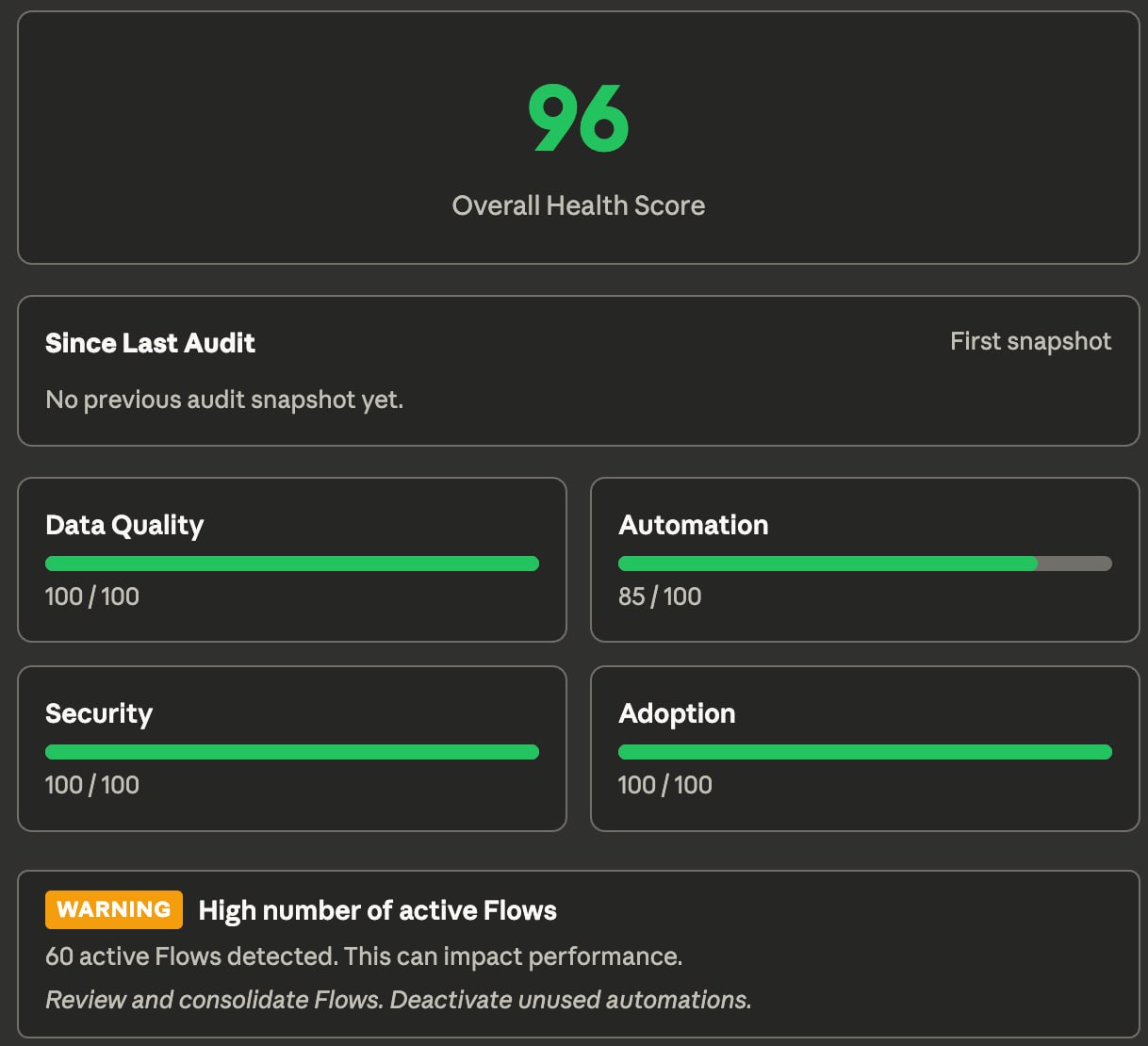
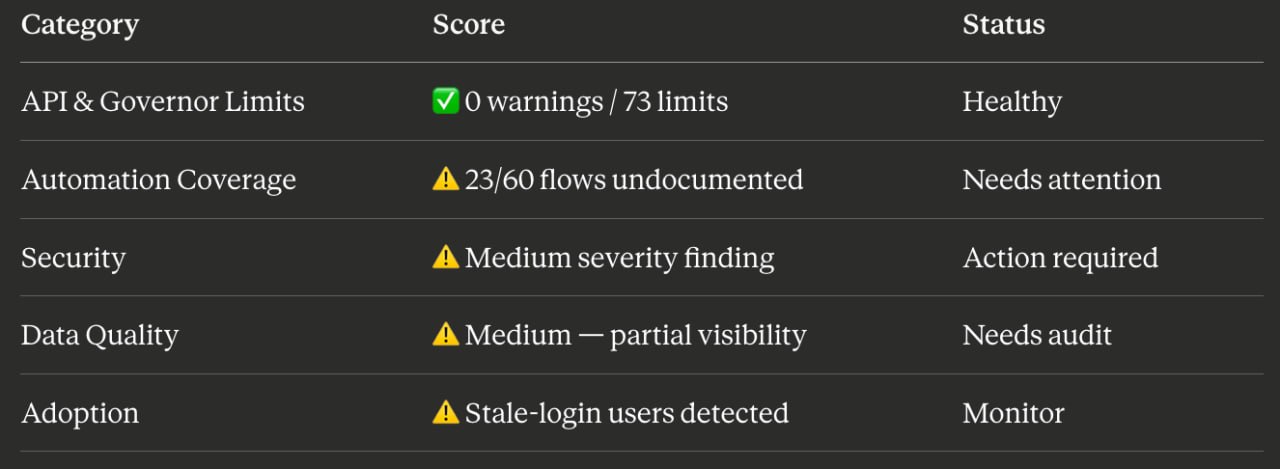
Start with real org signals. Move to human review only when the risk and next step deserve it.
Connect a Salesforce sandbox or production org through Claude and Nexus MCP. Get a signal-only report across data, automation, access, and adoption.
If the scan shows risk, Nexus reviews the findings and turns them into ranked blockers, candidate use cases, and a 30/60/90 cleanup path.
Fix the first blocker with written scope, acceptance criteria, and async updates.
Choose an agent use case only after the data risk and action risk are known.
Offers
AI Readiness Blueprint
€2,500 founding price
A 5-business-day async review that turns the free check into a practical readiness roadmap.
Cleanup Sprint
Scoped separately
Bounded async implementation after the Blueprint shows which blocker matters first.
The Blueprint gives you the roadmap. Cleanup work and agent buildout are scoped separately.
Nexus focuses on whether AI agents can safely answer, act, and escalate on top of your org.
You get a lighter-weight signal check plus senior judgment. No platform rollout required to start.
The Blueprint is fixed-scope, async, and delivered in 5 business days before implementation spend.
You get an outside AI-risk lens and a ranked roadmap your team can validate or execute.
Nexus ranks risk and AI use-case fit before touching automation, metadata, or permissions.
AI readiness is not a platform checkbox. It depends on Salesforce data, permissions, automation, and how your revenue team works.
You get one accountable operator, written decisions, and Salesforce implementation only after the risk and scope are clear.
Revenue operations experience shapes the recommendation before any cleanup starts.
Nexus can handle admin work, automation, integrations, and code-heavy Salesforce fixes once the scope is clear.
The same operator perspective connects the first diagnostic, the Blueprint, and any scoped cleanup work.
A readiness score turns vague AI risk into something a RevOps team can discuss.
How RevOps teams can pick the first blocker instead of starting a broad cleanup program.
AI tools need the business meaning behind fields, flows and handoffs before they act.
Find the risks, decide the cleanup path, and choose the first safe AI pilot.
Runs in Claude through Salesforce OAuth. Sandbox supported. You see access details before approving.


